Why Hail is the "New Hurricane" (And Why It’ll Change the Way You Look at Property Insurance)
- gabeinsurancesolut
- Mar 30
- 5 min read
If you live in Texas, you know the sound. It starts with a low rumble, the sky turns an unsettling shade of bruised purple, and then it hits: the rhythmic thwack of ice hitting your roof.
Ten years ago, a bad hail storm was a local news story and a nuisance for your car’s hood. Today, in 2026, hail has officially graduated. It is no longer just a "weather event"; it has become the "New Hurricane."
For homeowners and insurance carriers alike, hail is the single most disruptive force in the property and casualty market. If you haven’t looked at your policy since the start of the year, there’s a high probability that the way you’re protected against hail has fundamentally shifted without you even realizing it.
Why the "Hurricane" Label Matters
When we think of hurricanes, we think of catastrophic, billion-dollar losses that reshape entire coastlines. We think of state-mandated pools like TWIA and massive premium spikes.
Hail is now hitting those same financial notes, but with one major difference: geography.
A hurricane is a coastal problem. Hail is an everywhere problem. In 2026, data shows that hail accounts for roughly 45.5% of all homeowners insurance claims nationwide. In Texas, that number is often higher. Because hail strikes unpredictably across vast regions, carriers can’t "map out" the risk as easily as they do with flood zones.
This unpredictability is causing a surgical shift in how insurance companies write policies. They aren't just raising prices anymore; they are changing the rules of the game.
The 2026 Reality: Why Your Premium Just Jumped
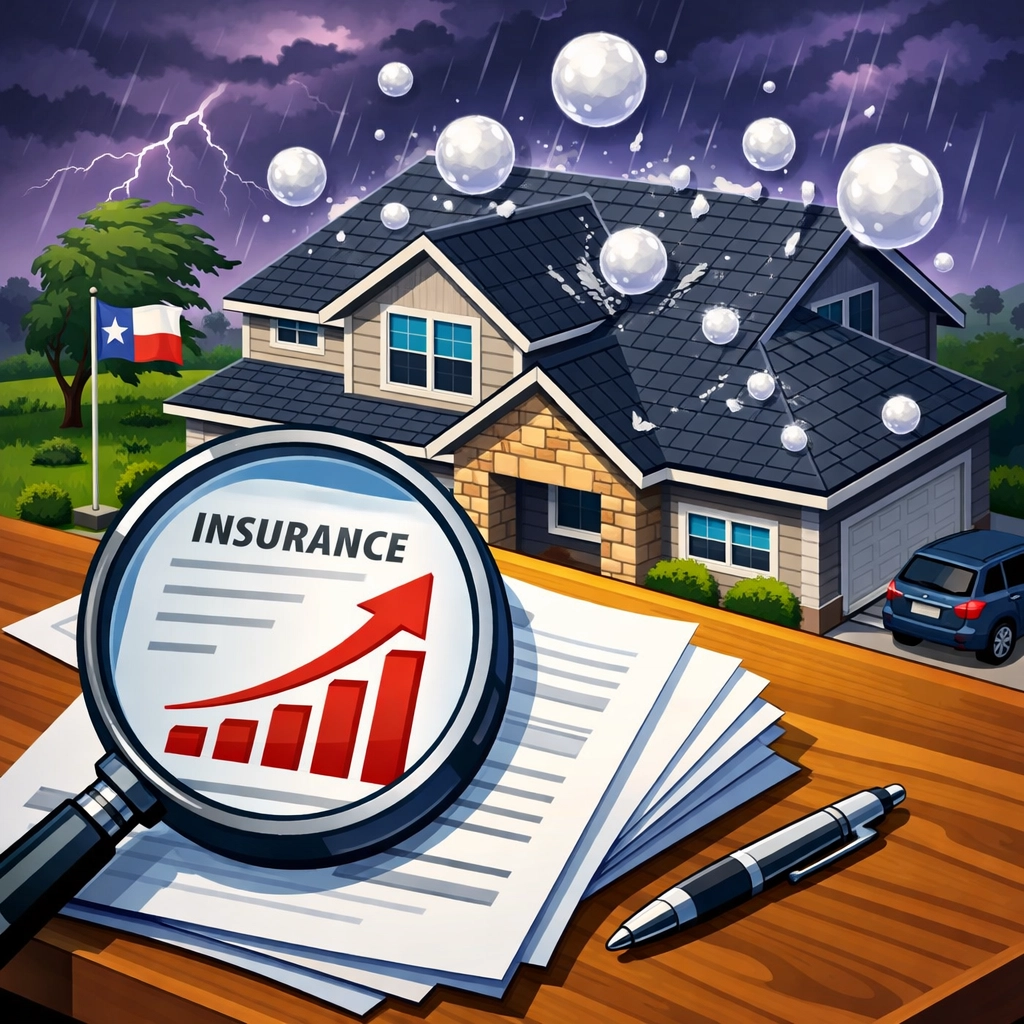
If you’ve received your renewal notice recently, you might have noticed a number that looks like a typo. It’s not. In high-risk states like ours, premiums are surging: sometimes by 50% or more.
Why? Because the average cost of a hail claim has ballooned to over $11,000. When you multiply that by a single storm system that rolls through North Texas and hits 50,000 homes in one afternoon, you’re looking at a half-billion-dollar event.
Carriers are responding by:
Market Withdrawal: Some big-name insurers are simply stopping new business in certain zip codes. If they can’t price the risk accurately, they’d rather not take the risk at all.
Stricter Underwriting: Getting a policy on an older roof is becoming nearly impossible. If your roof is over 10–12 years old, carriers are either demanding a full replacement before they'll sign you or excluding hail damage entirely.
The "Surgical" Changes to Your Policy
This is where you need to pay attention. The industry is moving away from "blanket" coverage and toward more specific, limited forms of protection. Here are the three trends defining 2026 property insurance:
1. The Rise of the Percentage Deductible
In the past, most homeowners had a flat $1,000 or $2,500 deductible. In 2026, that is becoming a relic of the past. Most carriers are now moving toward a percentage-based hail deductible.
If your home is insured for $500,000 and you have a 2% hail deductible, you are on the hook for the first $10,000 of repairs. This is a massive shift in financial responsibility from the insurance company to the homeowner. You might think you have "great coverage," but if you don't have $10k sitting in a high-yield savings account, a hail storm could be a financial disaster.
2. ACV vs. RCV (The Depreciation Trap)
This is perhaps the most important "surgical" insight we can offer.
RCV (Replacement Cost Value): The insurance company pays to replace your roof with a brand-new one of similar quality.
ACV (Actual Cash Value): The insurance company pays you what your roof is worth today, accounting for age and wear-and-tear.
More carriers are switching hail coverage to ACV by default to keep premiums "low." If your 15-year-old roof gets destroyed and you have an ACV policy, the check you get might only cover 30% of the cost of a new roof. For a deeper dive into these types of traps, check out our post on 10 insurance mistakes homeowners make.
3. Cosmetic Damage Exclusions
In 2026, we’re seeing a surge in "Cosmetic Damage Waivers." This means if the hail dents your metal roof or scuffs your siding but doesn't actually cause a leak or structural failure, the insurance company won't pay to fix it. To them, it’s an aesthetic issue, not a functional one.
How to Protect Yourself (Beyond the Policy)
Being an "educated homeowner" means more than just paying your bill. It means being proactive about your property’s "resilience."
Hardening the Property: If you are replacing your roof this year, look into Class 4 impact-resistant shingles. Not only do they survive hail better, but many carriers will offer a significant discount on your premium for having them.
Annual Maintenance: Don't wait for a storm to check your roof. Small issues like loose shingles or clogged gutters can turn a minor hail event into a major interior leak.
Get a Policy Audit: Don't wait for the sky to turn purple to find out you have a 2% deductible and an ACV policy.

The Strategic Path Forward
At Eagle-Watch Solutions, we believe in "surgical" insurance. We don't just throw a policy at you and hope for the best. We look at the 2026 climate trends, the carrier shifts, and your specific property to find the holes in your protection.
The "New Hurricane" isn't going away. As long as the Texas sun keeps heating the atmosphere and the cold fronts keep rolling in, we’re going to have hail. The difference between a homeowner who loses their savings and a homeowner who bounces back is strategic guidance.
If you haven't looked at the fine print of your policy lately, you might be at risk. We've seen a lot of insurance regulation updates recently that impact how these claims are handled in Texas.
Quick Takeaways for 2026:
Hail is the primary driver of property insurance rate hikes in Texas right now.
Check your deductible. Is it a flat dollar amount or a percentage of your home's value?
Verify your valuation. Do you have Replacement Cost (RCV) or Actual Cash Value (ACV) for hail?
Upgrade your materials. Impact-resistant roofs are the best way to lower your long-term costs.

Take the Next Step
Don't let the next storm catch you off guard. Whether you are a homeowner or a business owner, your property is likely your largest asset. Protecting it requires more than a "set it and forget it" attitude: it requires an expert eye.
We specialize in helping Texas homeowners navigate these turbulent waters with clear, jargon-free advice.
Ready to see where you stand?
Get quoted today
Free coverage review
Watching over what matters most. www.eaglewatchsolutions.com

Comments