Is Your Business "Uninsurable"? How to Navigate the 2026 Climate Risk Crisis
In 2026, the conversation around Texas business insurance has shifted. It’s no longer just about how much your premium will increase this year. For many business owners in the Lone Star State, the question has become much more existential: Can I even get coverage?
We are entering an era where certain sectors and geographic zones are being labeled "uninsurable." Between the recurring "thousand-year" freezes, baseball-sized hail, and coastal volatility, traditional carriers are pulling back. If you own a business in Texas, understanding this climate risk crisis isn't just about paperwork, it’s about survival.
The 2026 Reality: From Volatility to Absence
For decades, insurance was a predictable expense. You paid your premium, and if a storm hit, you were made whole. But global reinsurers, the massive companies that insure the insurance companies, have changed their math. In the first half of 2025 alone, global natural disasters caused $131 billion in losses. A significant portion of that hit the U.S. sunbelt, with Texas at the epicenter.
When risk becomes too frequent, it stops being "insurance" and starts being "maintenance." Carriers aren't interested in covering maintenance. This has led to the "uninsurability frontier."
If your business is located in a high-risk flood zone or a region prone to severe convective storms (the kind that produce major hail), you might find that your renewal notice comes with a "non-renewal" stamp. Or, perhaps worse, a premium that exceeds 5% of your total property value.
Quick Takeaway: The Warning Signs
Your business might be heading toward uninsurability if:
You’ve received multiple non-renewals in the last 24 months.
Your deductible for wind and hail has climbed to 5% or 10% of the building value.
Carriers are requiring "cosmetic damage" waivers for your roof.
You are seeing mandatory exclusions for specific types of weather events.
Why Texas is the Testing Ground
Texas is unique. We have a massive economy built on coastal trade, agriculture, and high-tech manufacturing, all of which are sensitive to the environment.
The "New Hurricane" in Texas isn't just a tropical storm; it’s the combination of extreme freezes that burst pipes across entire cities and hail storms that strip the roofs off industrial parks in minutes. These events used to be rare. Now, they are seasonal.
Because of this, 2026 property trends show that climate and technology are fundamentally rewriting how policies are priced. If your data doesn't show resilience, your business is a liability the markets don't want to touch.
The Regulatory Squeeze
It’s not just the weather; it’s the rules. New 2026 insurance regulations have forced carriers to be more transparent about their risk concentrations. This means they can't just "hide" a high-risk Texas portfolio inside a safer national one.
We’ve seen a surge in surcharges and mandatory updates to how policies are structured. For a deep dive into how this affects your bottom line, check out why the new 2026 Texas surcharge will change the way you budget for business insurance.
How to "Harden" Your Business to Stay Insurable
If the traditional market is pulling back, your job as a business owner is to prove that your specific property is an outlier, that you are "hardened" against the risks others ignore. Insurability in 2026 is earned, not given.
1. Physical Asset Hardening
Don't wait for a claim to upgrade your infrastructure. Carriers are now using high-resolution satellite imagery and AI to inspect roofs before they even offer a quote.
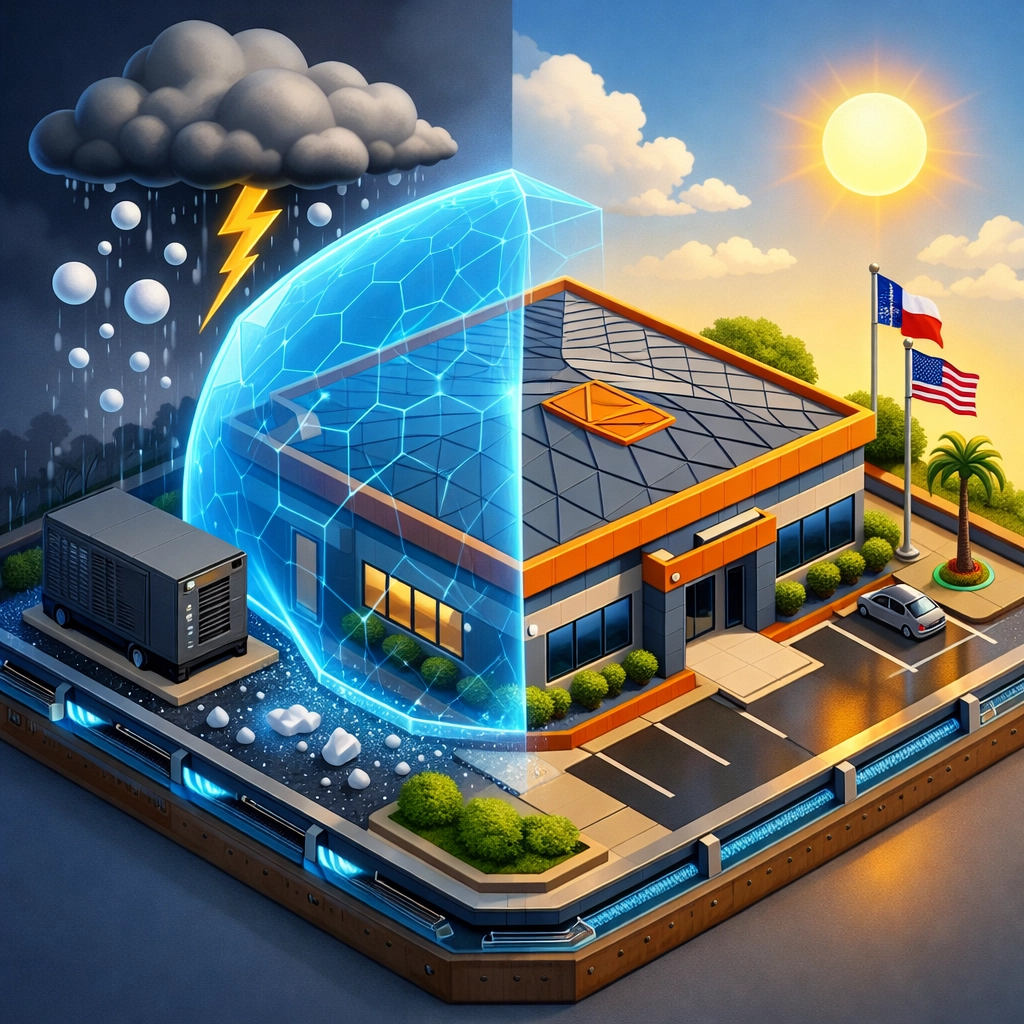
Roofing: Upgrade to Class 4 impact-resistant shingles or metal roofing systems.
Drainage: Ensure commercial properties have secondary drainage systems that exceed local code to handle "flash flood" intensity.
Power: Install permanent backup generators and insulate all external and internal plumbing to survive a multi-day freeze.
2. Operational Redundancy
If your physical location is compromised, can your business still function? Insurers are looking at "Business Interruption" risk.
Digital Hubs: Move critical data to cloud-based systems located outside the Texas power grid.
Supply Chain: Map your suppliers. If all your key vendors are also in high-risk Texas zones, your "contingent business interruption" risk is too high.
3. Data Transparency
Be ready with a "Risk Resume." This is a document that outlines every upgrade, every maintenance check, and every mitigation strategy you’ve implemented. When a broker takes your file to the market, a Risk Resume can be the difference between a "No" and a "Yes."
Strategic Coverage Navigation
When the standard market says no, you have to get strategic. The 2026 landscape offers new tools that weren't mainstream five years ago.
Parametric Insurance: The 2026 Default
Traditional insurance pays you based on the damage you sustained. Parametric insurance pays you based on an event.
Example: If a wind gust of 100mph is recorded at your zip code, the policy pays out a pre-set amount instantly. No adjusters, no long disputes. For many Texas small businesses, parametric policies are becoming the primary way to handle weather risk while using traditional policies for catastrophic overhead.
Layered Coverage
Instead of one massive policy, we are seeing more businesses "layer" their coverage. This involves having one carrier cover the first $500,000 of risk and another carrier covering the "excess" above that. It spreads the risk and makes your business more attractive to individual carriers.
For more on how to structure these protections, see our simple guide to liability and property coverage.
The Hidden Cost of Doing Nothing
If you lose insurability, the consequences aren't just about paying for repairs out of pocket. It’s a domino effect:
Mortgage Defaults: Most commercial loans have clauses that require you to maintain specific insurance levels. If you lose coverage, the bank can call your loan due immediately.
Valuation Plunge: A commercial building that is "uninsurable" is a building that is nearly impossible to sell.
Procurement Failures: Modern corporate contracts often require proof of insurance. If you can't provide it, you lose your biggest clients.

Your 2026 Survival Checklist
To navigate this crisis, you need a proactive framework. Don't wait for the renewal notice to arrive 30 days before your policy expires.
Conduct a 20-Year Climate Audit: Look at the projections for your specific Texas region. Is the flood map changing? Is the "hail belt" shifting?
Stress Test Your Financials: If your insurance costs tripled tomorrow, would your business still be viable? If not, you need to start hardening assets now to lower your risk profile.
Explore Alternative Risk Transfer: Talk to an expert about captive insurance or parametric triggers.
Review Regulatory Changes: Stay updated on how the Texas Department of Insurance is reacting to market withdrawals.
The 2026 climate risk crisis is real, but it is manageable for those who treat insurance as a strategic pillar rather than a line-item expense.

At Eagle-Watch Solutions, we specialize in helping Texas business owners navigate these complex waters. We don't just find you a policy; we help you build a more resilient business that the market is eager to protect.
Don't wait until you're "uninsurable" to start the conversation.
Get quoted today or reach out for a Free coverage review to see where your business stands in the 2026 landscape.
Comments